
What Is Childhood Anxiety? A Parent's Complete Guide

Dr. Jill Gitten Aloia, PhD, ABPP-CN
Chief Neuropsychologist at Kinspire · Board-certified clinical neuropsychologist with 25 years of experience in neurodevelopmental differences · Full bio →
· 8 min read
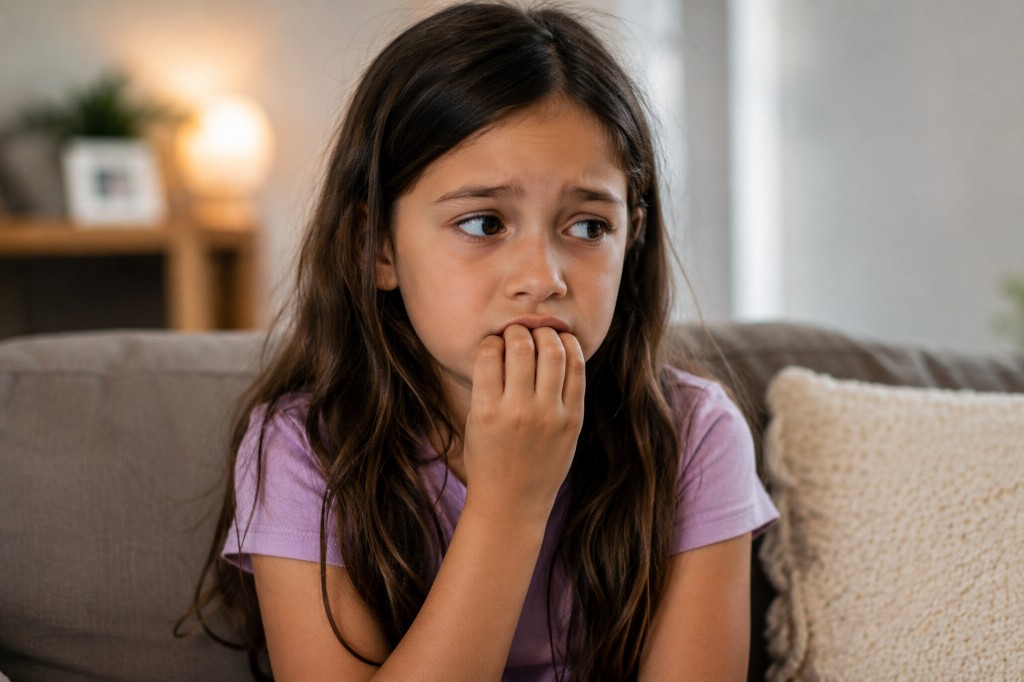
You've watched your child cry before school every single morning for three weeks. You've held them through meltdowns at birthday parties that were supposed to be fun. You've heard "my stomach hurts" so many times you've started to wonder if something is physically wrong — and maybe you've even taken them to the pediatrician more than once to rule it out. What you might not yet know is that what you're witnessing has a name, and it's far more common than most parents realize.
Anxiety in children is not a character flaw, a parenting failure, or a phase they'll simply grow out of — it's a neurological pattern that responds remarkably well to the right support.
What Anxiety Actually Is (And Isn't)
Anxiety is the brain's threat-detection system — the alarm that fires when danger is perceived. In small doses, it's protective. A little anxiety helps your child look both ways before crossing the street, study for a test, or feel appropriately cautious around strangers. The problem emerges when that alarm system becomes oversensitive — firing in situations that aren't actually dangerous, firing too loudly, or refusing to turn off even after the threat has passed.
For children, anxiety doesn't always look like worry. It can look like anger. It can look like avoidance. It can look like stomachaches, headaches, and an endless stream of "I don't feel well" on Monday mornings. It can look like a child who clings to you at drop-off, or a child who seems fine at home but shuts down completely at school. Parents often describe their anxious children as "intense," "sensitive," or "strong-willed" — and they're not wrong. But underneath that intensity is usually a nervous system working overtime.
Anxiety disorders are the most common mental health condition in childhood, affecting approximately 1 in 5 children and adolescents. Yet many go undiagnosed for years — not because the signs aren't there, but because adults around them misread the signals. The child who won't sleep alone is labeled "manipulative." The child who refuses school is called "defiant." The child who peppers you with questions about death or illness is told they're "dramatic." These misreadings delay treatment and, in the meantime, the anxiety deepens.
Clinically, we distinguish between anxiety as a normal developmental experience and anxiety as a disorder. The line isn't about the presence of fear — all children experience fear. The line is about whether the fear is proportionate to the situation, whether it persists over time, and whether it meaningfully interferes with your child's daily life, relationships, or development.
The Different Faces of Childhood Anxiety
Anxiety in children doesn't come in one flavor. Understanding which type your child is experiencing matters, because different anxiety presentations respond to different approaches.
Generalized Anxiety Disorder (GAD)
GAD is what most people picture when they think of anxiety: a child who worries about everything. School performance, natural disasters, family finances, whether they said the wrong thing three days ago, whether their friend is mad at them. The worry jumps from topic to topic, is hard to control, and is often accompanied by physical tension — tight shoulders, headaches, trouble sleeping. These children are frequently described as "little adults" or "old souls" because they carry weight that doesn't belong to them.
Separation Anxiety
Separation anxiety is developmentally normal in toddlers but becomes clinically significant when it persists beyond age 6 or 7, or re-emerges after a period of independence. Children with separation anxiety experience intense distress when away from their primary attachment figures — and often experience anticipatory anxiety just thinking about separation. School refusal is a common manifestation.
Social Anxiety Disorder
Social anxiety goes far beyond shyness. Children with social anxiety experience significant fear of judgment, embarrassment, or humiliation in social situations. They may avoid raising their hand in class, eating in the cafeteria, joining group activities, or attending birthday parties. They often have a very clear internal experience of wanting to connect with peers but feeling genuinely unable to.
Specific Phobias
Specific phobias involve intense, disproportionate fear of a specific object or situation — dogs, vomiting, needles, the dark, thunderstorms. The fear is recognized as excessive even by the child, but that recognition doesn't reduce its intensity.
Panic Disorder
Panic disorder in children is less common but underrecognized. Panic attacks — sudden surges of intense physical symptoms (racing heart, shortness of breath, dizziness, nausea) along with terror — can occur in school-age children and are often initially interpreted as medical emergencies.
Clinical Note
Many anxious children have more than one type of anxiety, and anxiety frequently co-occurs with ADHD, OCD, and depression. A comprehensive evaluation can help clarify the full picture and guide the most effective treatment approach.
Why Anxious Children Look Difficult
One of the most painful parts of parenting an anxious child is watching them be misunderstood. Teachers see defiance. Coaches see a lack of effort. Other parents see a spoiled child. And sometimes, if you're being honest, you've wondered yourself whether you're enabling the behavior.
Here's what the neuroscience tells us: when your child's threat-detection system fires, their prefrontal cortex — the part of the brain responsible for reasoning, perspective-taking, and impulse control — goes offline. In that moment, your child is not choosing to melt down. They are not being manipulative. Their brain is in genuine survival mode, and the behaviors you're seeing are the output of a system in crisis.
This is important for two reasons. First, it means that logical reassurance in the moment — "there's nothing to be scared of," "just calm down," "you're fine" — rarely works. An offline prefrontal cortex cannot process logical arguments. Second, it means that punishment for anxiety-driven behaviors — taking away privileges, sending a child to their room for refusing to go to school — doesn't reduce anxiety. It adds shame on top of fear, which typically makes the anxiety worse.
Understanding the neurological basis of your child's anxiety doesn't mean removing all expectations. It means calibrating your approach to meet your child where their brain actually is.
When to Seek Professional Help
Not every anxious moment requires clinical intervention. But certain patterns should prompt a conversation with your pediatrician or a referral to a child psychologist:
Signs to watch for
- →Anxiety that persists for more than a few weeks and doesn't respond to reassurance
- →Anxiety that causes your child to avoid developmentally important activities (school, friendships, family events)
- →Physical complaints (stomachaches, headaches, nausea) without a medical explanation
- →Sleep problems — difficulty falling asleep, frequent nightwaking, or strong resistance to sleeping alone
- →A child who seems "wound up" much of the time, has trouble relaxing, or is significantly irritable
- →Regression in previously mastered skills
- →Your child expressing hopelessness, feeling like something bad is always about to happen, or making statements about not wanting to be here
The gold-standard treatment for childhood anxiety is Cognitive Behavioral Therapy (CBT), specifically a variant called Exposure and Response Prevention (ERP) for anxieties with strong avoidance patterns. The research on CBT for pediatric anxiety is among the strongest in all of child mental health — with response rates of 60–80% in well-controlled trials. Medication, typically SSRIs, is sometimes recommended alongside therapy for moderate-to-severe anxiety. The combination of CBT and medication tends to produce the best outcomes for children with significant anxiety.
Early intervention matters. Anxiety disorders that go untreated in childhood are associated with higher rates of depression in adolescence, academic underachievement, and more treatment-resistant anxiety in adulthood. Getting help now is genuinely one of the most important things you can do for your child's long-term wellbeing.
How Kinspire Helps
Supporting Parents Raising an Anxious Child
At Kinspire, we know that navigating a child's anxiety isn't just hard for the child — it's exhausting, disorienting, and often isolating for parents. You're fielding morning meltdowns, fielding calls from school, Googling at midnight, and trying to figure out whether you're helping or making things worse. That uncertainty is one of the most stressful parts. Kinspire's parent coaching model is built around a simple premise: when parents understand anxiety and know how to respond to it, children get better faster.
Clinical Knowledge in Plain Language
Our approach gives you the clinical knowledge you need — on your schedule, without jargon — so you understand what's happening in your child's nervous system and why.
Tools for Real-Life Mess
We help you apply what you learn to the specific, messy situations you're facing with your child. We're not here to tell you what you're doing wrong. We're here to hand you tools that actually work.
Coaches Who Get It
Our coaches work with you on reading your child's anxiety signals before they escalate, responding in ways that reduce anxiety without reinforcing it, and building a home environment where anxious children feel safe enough to take risks. The goal isn't a child who never feels anxious — it's a child who has the tools to move through anxiety and back into their life.
Start for free. Grow from there.
Your Kinspire journey starts the moment you join — no waitlist, no referral needed.
- 1
Complete Our Initial Consultation
Not a questionnaire — a conversation. Dawn learns about your child's body, mind, and nervous system from the very first session.
- 2
Get Resources Built for Your Family
Receive step-by-step guidance, deep dives, and insights made specifically for your family's situation.
- 3
Access Live Sessions with Clinicians
Join live group sessions and get answers from Kinspire's OT and neuropsychology team — clinicians who can see the whole picture.
Questions Parents Are Actually Asking
Is my child's anxiety my fault?+
Anxiety has a strong genetic component — it tends to run in families. If you or your partner struggle with anxiety, your child is at higher risk. That's genetics, not blame. Parenting style can influence how anxiety develops, but it's rarely the root cause. The more useful question isn't "whose fault is this" but "what can we do about it."
Can anxiety go away on its own?+
Sometimes mild situational anxiety resolves once a stressor passes. But clinical-level anxiety disorders rarely resolve without intervention. More commonly, untreated anxiety leads to increasing avoidance, which narrows a child's world over time. Early, appropriate treatment dramatically improves outcomes.
My child's anxiety is worse at home than at school. Does that mean I'm doing something wrong?+
Not at all — in fact, it's very common. Children hold themselves together at school by sheer effort, then release the pressure valve at home where they feel safe. The fact that your child's anxiety is worse with you often means they feel most secure with you. It doesn't mean school is the solution or home is the problem.